




- My Forums
- Tiger Rant
- LSU Recruiting
- SEC Rant
- Saints Talk
- Pelicans Talk
- More Sports Board
- Fantasy Sports
- Golf Board
- Soccer Board
- O-T Lounge
- Tech Board
- Home/Garden Board
- Outdoor Board
- Health/Fitness Board
- Movie/TV Board
- Book Board
- Music Board
- Political Talk
- Money Talk
- Fark Board
- Gaming Board
- Travel Board
- Food/Drink Board
- Ticket Exchange
- TD Help Board
Customize My Forums- View All Forums
- Show Left Links
- Topic Sort Options
- Trending Topics
- Recent Topics
- Active Topics
Started By
Message
TMTG / TAE merger - fusion reactors
Posted on 12/18/25 at 8:32 pm

Posted on 12/18/25 at 8:32 pm
Global News Wire - TMTG / TAE merger
American Fusion
https://futurumgroup.com/research-reports/tae-technologies-americas-answer-to-fusion-energy-and-why-it-matters-for-ai-dominance/
quote:
Trump Media & Technology Group to Merge with TAE Technologies, a Premier Fusion Power Company, in All-Stock Transaction Valued at More Than $6 Billion
quote:
SARASOTA, Fla. and FOOTHILL RANCH, Calif., Dec. 18, 2025 (GLOBE NEWSWIRE) -- Trump Media & Technology Group Corp. (Nasdaq, NYSE Texas: DJT) (“TMTG”) and TAE Technologies, Inc. (“TAE”) today announced the signing of a definitive merger agreement to combine in an all-stock transaction valued at more than $6 billion.
Upon closing, shareholders of each company will own approximately 50% of the combined company on a fully diluted equity basis. The companies have posted supplemental slides to their respective websites, all of which can be accessed at tmtgcorp.com and tae.com.
quote:
Highlights:
Transaction to create one of the world’s first publicly traded fusion companies. Deal to combine TMTG’s access to significant capital and TAE’s leading fusion technology.
In 2026, the combined company plans to site and begin construction on the world’s first utility-scale fusion power plant (50 MWe), subject to required approvals.
Additional fusion power plants are planned and expected to be 350 – 500 MWe.
Fusion power plants are expected to provide economic, abundant, and dependable electricity that would help America win the A.I. revolution and maintain its global economic dominance.
TMTG’s balance sheet to accelerate the path to power. The transaction will combine the strength of TMTG’s strong balance sheet with TAE’s leading technologies. As part of the transaction, TMTG has agreed to provide up to $200 million of cash to TAE at signing and an additional $100 million is available upon initial filing of the Form S-4.
TAE’s next-generation fusion technology is poised for commercial application. After more than 25 years of research and development, TAE has significantly reduced fusion reactor size, cost and complexity. TAE has built and safely operated five fusion reactors and raised more than $1.3 billion in private capital to date from Google, Chevron Technology Ventures, Goldman Sachs, Sumitomo Corporation of Americas, NEA, the visionary family offices of Addison Fischer, the Samberg Family, Charles Schwab, and others.
Loading Twitter/X Embed...
If tweet fails to load, click here. American Fusion
https://futurumgroup.com/research-reports/tae-technologies-americas-answer-to-fusion-energy-and-why-it-matters-for-ai-dominance/
This post was edited on 12/19/25 at 9:33 pm
 2
2

Posted on 12/18/25 at 8:33 pm to Kjnstkmn
Posted on 12/18/25 at 8:39 pm to Kjnstkmn
Also coincidentally
If you research TAE this is the exact science they hope to use in their primary path to commercial fusion using Hydrogen Boron which has zero radioactivity but requires much higher temps than their plan B backup fuel deuterium-tritium (DT).
If the Boron approach works out they can build the reactors right next to Wal Mart instead of having to put them in the boonies for safety reasons and will also face much less regulatory hurdles.
Loading Twitter/X Embed...
If tweet fails to load, click here. quote:
Professor Loureiro's specific focus was the biggest hurdle in this process: turbulence. When plasma gets hot, it becomes violent. It wants to escape the magnetic cage holding it. Loureiro developed complex mathematical theories and computer codes, such as Viriato, to predict and control this chaos. He was the expert on keeping the fuel hot enough to burn.
If you research TAE this is the exact science they hope to use in their primary path to commercial fusion using Hydrogen Boron which has zero radioactivity but requires much higher temps than their plan B backup fuel deuterium-tritium (DT).
If the Boron approach works out they can build the reactors right next to Wal Mart instead of having to put them in the boonies for safety reasons and will also face much less regulatory hurdles.
This post was edited on 12/18/25 at 8:46 pm

Posted on 12/18/25 at 8:59 pm to Kjnstkmn
In an earlier thread today on this subject I thought TAE needed He-3 for their fusion process. They don’t. The key fuel is boron. I asked grok for a summary of their process:
TAE Technologies (formerly Tri-Alpha Energy) is a U.S.-based company developing commercial nuclear fusion energy using a unique approach focused on aneutronic fusion with proton-boron (p-¹¹B or hydrogen-boron) fuel.
Core Process
Fusion energy involves fusing light atomic nuclei to release massive energy, mirroring the Sun’s power source. TAE’s process uses proton-boron fuel (p + ¹¹B ? 3 a + 8.7 MeV), producing three helium-4 nuclei (alpha particles) and energy without neutrons as primary byproducts. This aneutronic reaction avoids radioactive waste, material activation, and complex thermal cycles needed in neutron-producing fuels like deuterium-tritium (D-T).
Confinement Method: Field-Reversed Configuration (FRC)
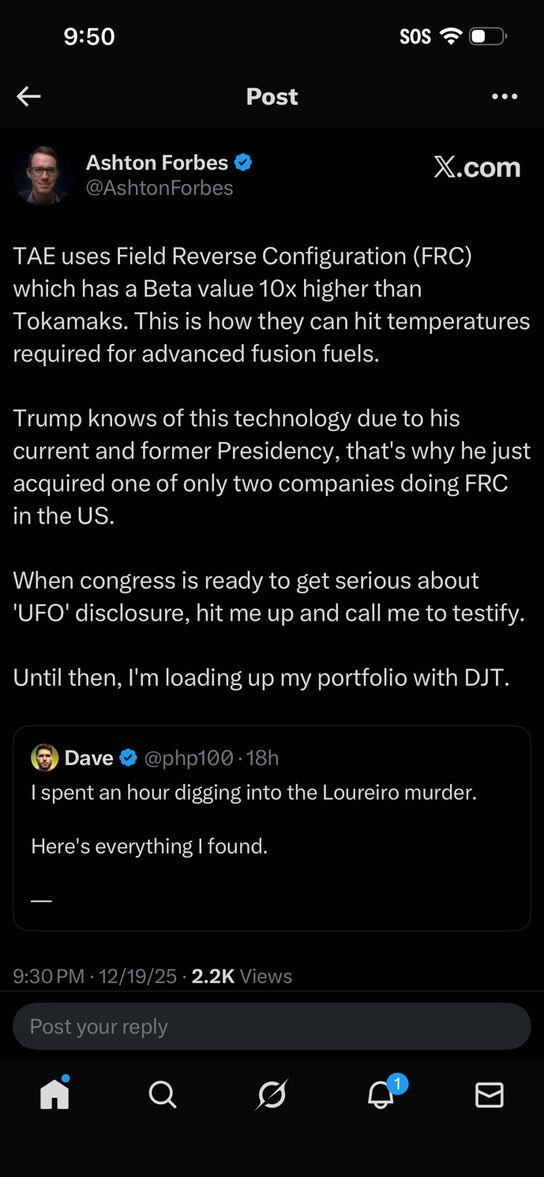
TAE employs a beam-driven Field-Reversed Configuration (FRC), a magnetic confinement technique. Plasma forms a self-organized, smoke-ring-like toroid (prolate compact toroid) where internal currents reverse the external magnetic field, enabling strong confinement with fewer external magnets than tokamaks. This linear, cylindrical design is simpler, more compact, cost-effective, and scalable, with high beta (plasma pressure to magnetic pressure ratio) for efficient power density.
Key Steps in the Process
1 Plasma Formation — Neutral beam injection (NBI) from particle accelerators creates and sustains the FRC plasma directly, eliminating complex theta-pinch systems used in earlier machines. This 2025 breakthrough in the “Norm” reactor simplifies design and reduces costs.
2 Heating and Sustainment — High-energy neutral beams inject tangentially, driving current, heating plasma to hundreds of millions of degrees Celsius (p-B¹¹B requires ~1 billion °C, far hotter than D-T’s ~100 million °C), and stabilizing against instabilities.
3 Confinement and Fusion — FRC’s self-confinement holds hot plasma long enough for collisions. Energetic ions from beams boost reaction rates in non-thermal distributions.
4 Energy Extraction — Charged alpha particles enable direct electrostatic conversion to electricity, bypassing inefficient steam turbines for higher efficiency and smaller plants.
Advantages of TAE’s Approach
• Cleanest Fuel ? Abundant (boron plentiful, hydrogen from water), no neutrons, no long-lived waste, no meltdown/proliferation risks.
• Economic/Practical ? Linear geometry eases maintenance; high performance at scale offsets p-B¹¹B’s lower reactivity.
• Progress ? Machines like “Norman” (2017, >70 million °C stable plasma) and “Norm” (2025, NBI-only FRC) demonstrate viability. Next goals include net energy and a prototype plant (e.g., Da Vinci).
TAE’s method promises carbon-free, on-demand baseload power, though p-B¹¹B’s high temperatures pose challenges overcome via innovative FRC and beam tech. The company targets commercial deployment in the 2030s.
TAE Technologies (formerly Tri-Alpha Energy) is a U.S.-based company developing commercial nuclear fusion energy using a unique approach focused on aneutronic fusion with proton-boron (p-¹¹B or hydrogen-boron) fuel.
Core Process
Fusion energy involves fusing light atomic nuclei to release massive energy, mirroring the Sun’s power source. TAE’s process uses proton-boron fuel (p + ¹¹B ? 3 a + 8.7 MeV), producing three helium-4 nuclei (alpha particles) and energy without neutrons as primary byproducts. This aneutronic reaction avoids radioactive waste, material activation, and complex thermal cycles needed in neutron-producing fuels like deuterium-tritium (D-T).
Confinement Method: Field-Reversed Configuration (FRC)
TAE employs a beam-driven Field-Reversed Configuration (FRC), a magnetic confinement technique. Plasma forms a self-organized, smoke-ring-like toroid (prolate compact toroid) where internal currents reverse the external magnetic field, enabling strong confinement with fewer external magnets than tokamaks. This linear, cylindrical design is simpler, more compact, cost-effective, and scalable, with high beta (plasma pressure to magnetic pressure ratio) for efficient power density.
Key Steps in the Process
1 Plasma Formation — Neutral beam injection (NBI) from particle accelerators creates and sustains the FRC plasma directly, eliminating complex theta-pinch systems used in earlier machines. This 2025 breakthrough in the “Norm” reactor simplifies design and reduces costs.
2 Heating and Sustainment — High-energy neutral beams inject tangentially, driving current, heating plasma to hundreds of millions of degrees Celsius (p-B¹¹B requires ~1 billion °C, far hotter than D-T’s ~100 million °C), and stabilizing against instabilities.
3 Confinement and Fusion — FRC’s self-confinement holds hot plasma long enough for collisions. Energetic ions from beams boost reaction rates in non-thermal distributions.
4 Energy Extraction — Charged alpha particles enable direct electrostatic conversion to electricity, bypassing inefficient steam turbines for higher efficiency and smaller plants.
Advantages of TAE’s Approach
• Cleanest Fuel ? Abundant (boron plentiful, hydrogen from water), no neutrons, no long-lived waste, no meltdown/proliferation risks.
• Economic/Practical ? Linear geometry eases maintenance; high performance at scale offsets p-B¹¹B’s lower reactivity.
• Progress ? Machines like “Norman” (2017, >70 million °C stable plasma) and “Norm” (2025, NBI-only FRC) demonstrate viability. Next goals include net energy and a prototype plant (e.g., Da Vinci).
TAE’s method promises carbon-free, on-demand baseload power, though p-B¹¹B’s high temperatures pose challenges overcome via innovative FRC and beam tech. The company targets commercial deployment in the 2030s.
Posted on 12/18/25 at 9:01 pm to Kjnstkmn
The amazing thing about this technology is:
quote:
Charged alpha particles enable direct electrostatic conversion to electricity, bypassing inefficient steam turbines for higher efficiency and smaller plants.
Posted on 12/19/25 at 10:11 pm to Sassafrasology

Posted on 12/19/25 at 10:23 pm to Kjnstkmn
Posted on 12/19/25 at 10:29 pm to Kjnstkmn
Posted on 12/19/25 at 10:54 pm to Kjnstkmn
Posted on 12/19/25 at 11:08 pm to Kjnstkmn
Did a little cursory research on the TAE reactor and it does need fuel. A steady stream of protons (hydrogen) and a steady steam of boron. But it’s not much. Like 200 grams of boron for a full year in one reactor. The fusion reaction between in proton and one boron temporarily creates carbon which converts to three alpha particles that converts directly into electricity.
If this technology becomes reliable and scalable, it’s an absolute game changer.
If this technology becomes reliable and scalable, it’s an absolute game changer.

Posted on 12/19/25 at 11:21 pm to Kjnstkmn
i like that that guy is clearly dumbing it down and i still have no idea what he's saying


 Page 1 of 1


Popular
Back to top
 Follow TigerDroppings for LSU Football News